Initial Objective
Use AI algorithms to supplement, support, review and automate process workflows for manufacturing.
Description
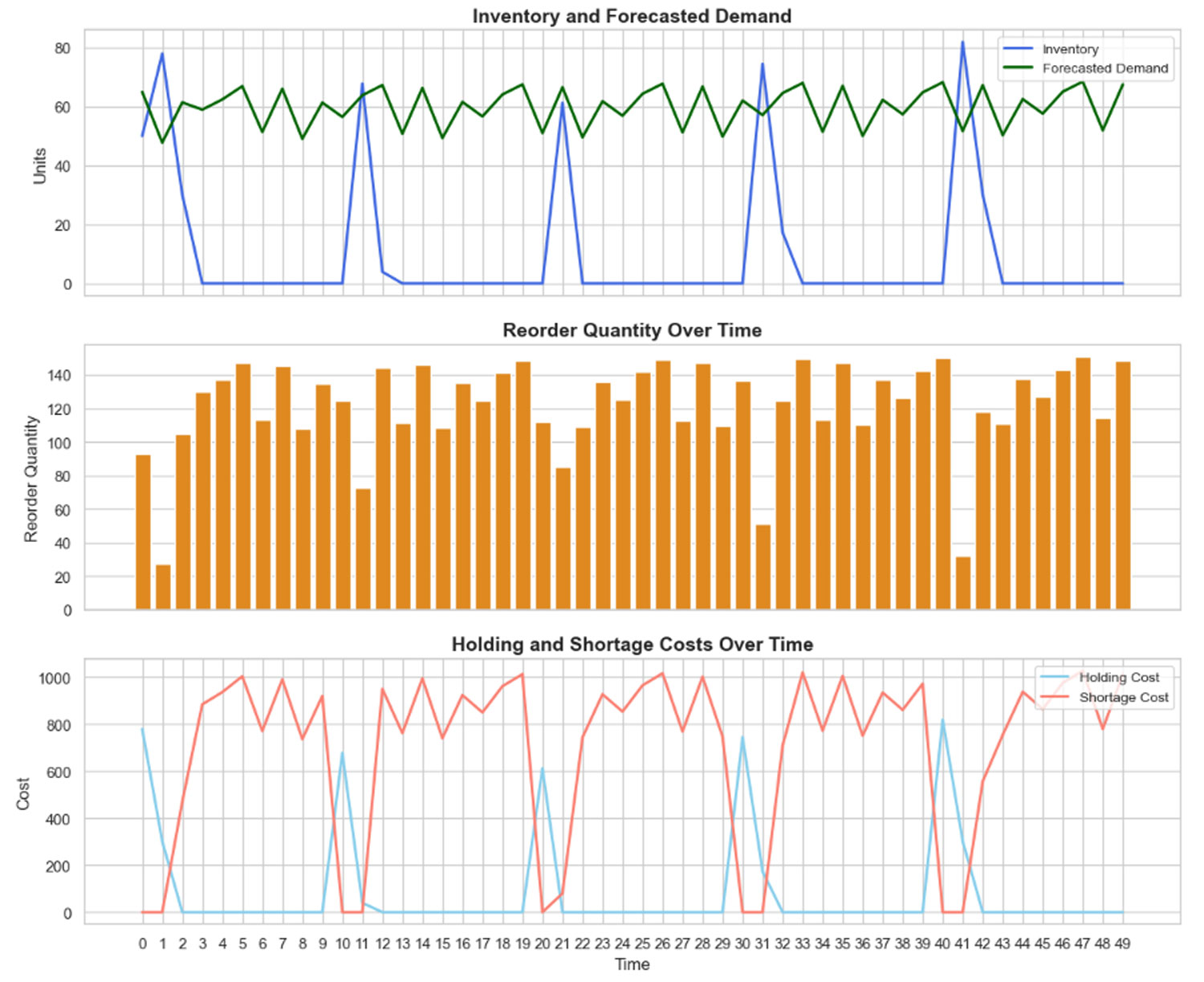
Efficient inventory management is crucial for any business that deals with physical products, from retail to manufacturing. The balance between too much and too little inventory is delicate: stockouts can halt production or disappoint customers, while excess stock ties up capital and adds holding costs. In this notebook, we’re developing a predictive approach to inventory management using SARIMA (Seasonal Autoregressive Integrated Moving Average) forecasting. This model helps anticipate future demand, enabling smarter, data-driven inventory decisions. By adjusting factors such as holding costs, shortage costs, and lead time, our model can help businesses decide the optimal times and quantities for reordering materials, ensuring that inventory levels are optimized for both cost efficiency and demand readiness.
This approach provides a simplified view of a complex system, illustrating a foundational technique. In practice, we incorporate far more data and layers of complexity into the models to capture the nuanced dynamics of inventory and production management more accurately.
Inventory Optimization with AI